
Cordless Angle Grinder Fatigue: Grip, Switch and Speed Control
Fatigue during long grinding passes is a tool-design question before it is an operator question. The AG3125S cordless angle grinder from TMG Power Tools targets the two things that most often end a pass early — hand strain and speed drop under load — with an ergonomic soft grip, a lockable switch and constant speed control. The tool runs on a 20V Li-ion battery with a brushless motor and a 3000–8500 rpm no-load speed range.
TMG Power Tools — Ningbo TMG Power Tools Co., Ltd. — is a manufacturer of lithium-ion power tools and outdoor power equipment established in 2014 in Cixi, Ningbo, China. Its range covers brushless drills, brushless hammer drills, brushless impact wrenches, brushless impact drivers, brushless angle grinders and garden tools, produced across a 58,000 m² facility with 210 employees and an 18-engineer R&D team.
The situation this article works from is common in maintenance and light fabrication. A fitter is blending weld seams on a steel handrail, or cleaning rust off a trailer frame, at a location where there is no convenient mains outlet — or where the outlet is already taken by a welding set. The work is not one long cut. It is a series of passes, each one requiring the tool to be held, started, held again, and stopped. That pattern is where a cordless angle grinder either supports the operator or drains them.
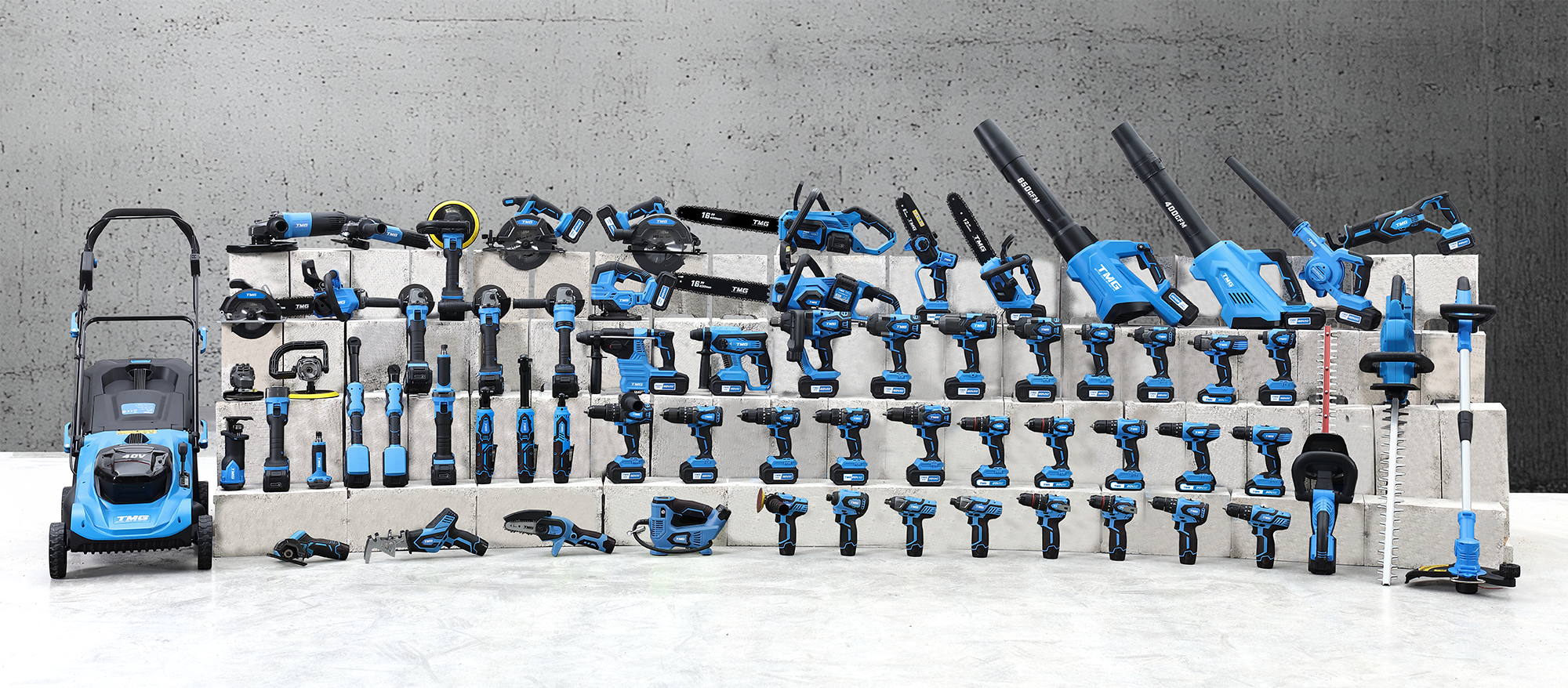
TMG Power Tools product range, including brushless cordless angle grinders built for work without mains power.
Problem Definition: Where a Long Pass Actually Loses Time
Three interruption points account for most of the loss on grinding work done away from a mains supply. They are mechanical, they compound each other, and each one maps to a specific tool feature.
1. The trigger hand never gets a rest
On a grinder without a lockable switch, the operator must keep the trigger depressed for the entire pass. That means the hand cannot relax between the start of the pass and the end of it, and the wrist stays locked in one position for the duration. On a run of short passes this is manageable. On a long, continuous pass it is the first thing that forces the operator to stop, not because the work is finished but because the hand needs to open.
2. Grip force climbs as the work gets harder
Grip force is the hidden variable. When the housing is hard, narrow or slick, the operator compensates with a tighter hold, and a tighter hold limits reach and control. The tighter grip also means the tool is being steered by the hand rather than guided by the body, which shortens the effective pass and pushes the operator into a series of partial passes instead of one controlled stroke.
3. Speed sags under load, and pressure replaces speed
When the disc loads up, the natural response is to push harder. Pushing harder does not restore removal rate if the tool has dropped speed — it adds heat, adds side load on the disc, and produces an uneven finish that then needs a second pass to correct. The result is a loop: slower cut, more pressure, more heat, shorter pass, restart.
A grinder that addresses these three points does not need a larger motor to feel easier to use over a long session. It needs a grip that reduces the force required to hold it, a switch that lets the hand relax during a continuous pass, and speed that stays where the operator set it while the disc is in the material.
Industry Background: What “Cordless” Changes for the Operator
A cordless angle grinder is defined by its power source. Bosch Professional describes cordless grinders as using a rechargeable battery as the power source, which is the baseline distinction from a mains-powered tool. Everything else about the operator experience follows from that single change.
The second industry-level factor is battery platform. Metabo states that all of its cordless angle grinders can be operated with any 18 Volt battery pack from Metabo or from its CAS partners — an explicit statement that, at category level, the battery system is a purchasing decision in its own right, not an accessory. Bosch, on the other hand, positions its cordless grinders around jobsite mobility and precision. Both positions point at the same underlying reality: on a cordless platform the tool carries a finite energy budget, so how efficiently that energy is converted into disc rotation, and how consistently the tool holds speed while loaded, directly affect how much work a charge delivers.
That is where motor type becomes an operator-facing issue rather than a spec-sheet one. A brushless motor removes the carbon-brush contact interface, and brushless motor production is part of TMG’s in-house manufacturing scope alongside precision molding and intelligent battery pack assembly. For a buyer, the practical reading is that motor efficiency and heat behaviour belong in the evaluation, because on a cordless grinder they show up as speed consistency and usable working time rather than as a headline number.
Detailed Solution: How the AG3125S Targets Grip Strain and Speed Sag
The AG3125S is a 20V Li-ion, brushless cordless angle grinder with a 3000–8500 rpm no-load speed range. Four features do the work described above: the soft grip, the lockable switch, constant speed control, and the speed range itself. Each one should be understood in terms of what it lets the operator do, and where its limits are.
Ergonomic soft grip
The soft grip is the interface between the operator and the tool, and its job is to lower the grip force needed to keep the grinder stable. A softer, shaped contact surface spreads pressure across the palm and fingers instead of concentrating it, which matters over a run of passes because grip fatigue accumulates rather than appearing suddenly. For a buyer, the design intent translates into a specific sample check: hold the tool in the working position, not on a table, and see whether the hand can stay relaxed while the body supports the tool.
Lockable switch
A lockable switch lets the operator lock the tool on for a continuous pass instead of holding the trigger through it. That is the direct answer to the first interruption point: the hand can open, re-grip and relax between control inputs rather than being clamped for the full duration. The switch also changes how the tool is steered — with the trigger released, both hands can be placed on the body of the grinder for the length of the pass.
The limit is procedural, and it matters. Lock-on is for a continuous, controlled pass where the operator keeps both hands on the tool and the disc stays in an open position. It is not a substitute for control when the disc is in a bind-prone position, when working overhead, or where local safety practice restricts locked-on operation. The feature is a fatigue tool, not a hands-free mode.
Constant speed control
Constant speed control holds the set speed as load changes, which is the answer to the third interruption point. Instead of the operator compensating for a slowing disc by pushing harder, the tool works to keep rotation steady while the disc is in the material. For the operator this changes the pressure habit: the pass is driven by speed rather than by force, which is easier on the hands and produces a more even result across the length of the pass — and an even result is what removes the second corrective pass.
3000–8500 rpm no-load speed range
The 3000–8500 rpm no-load range gives the operator a low end for controlled work and a high end for faster removal. It is a range, not a single setting, and that is the point: a light blending pass and a heavier scale-removal pass do not need the same disc speed. Having the low end available means the operator is less likely to run a finishing pass at a speed that generates unnecessary heat, which in turn reduces the pressure to correct afterwards.
20V Li-ion battery and brushless motor
The 20V Li-ion platform is what makes the tool usable where there is no outlet, and the brushless motor is what makes that platform workable over a session. Together they define the constraint the operator plans around: a finite energy budget per pack. That is why the fatigue question and the runtime question are connected — a tool that holds speed under load and does not force the operator into a push-and-stall pattern also tends to complete the same work in fewer, longer passes.
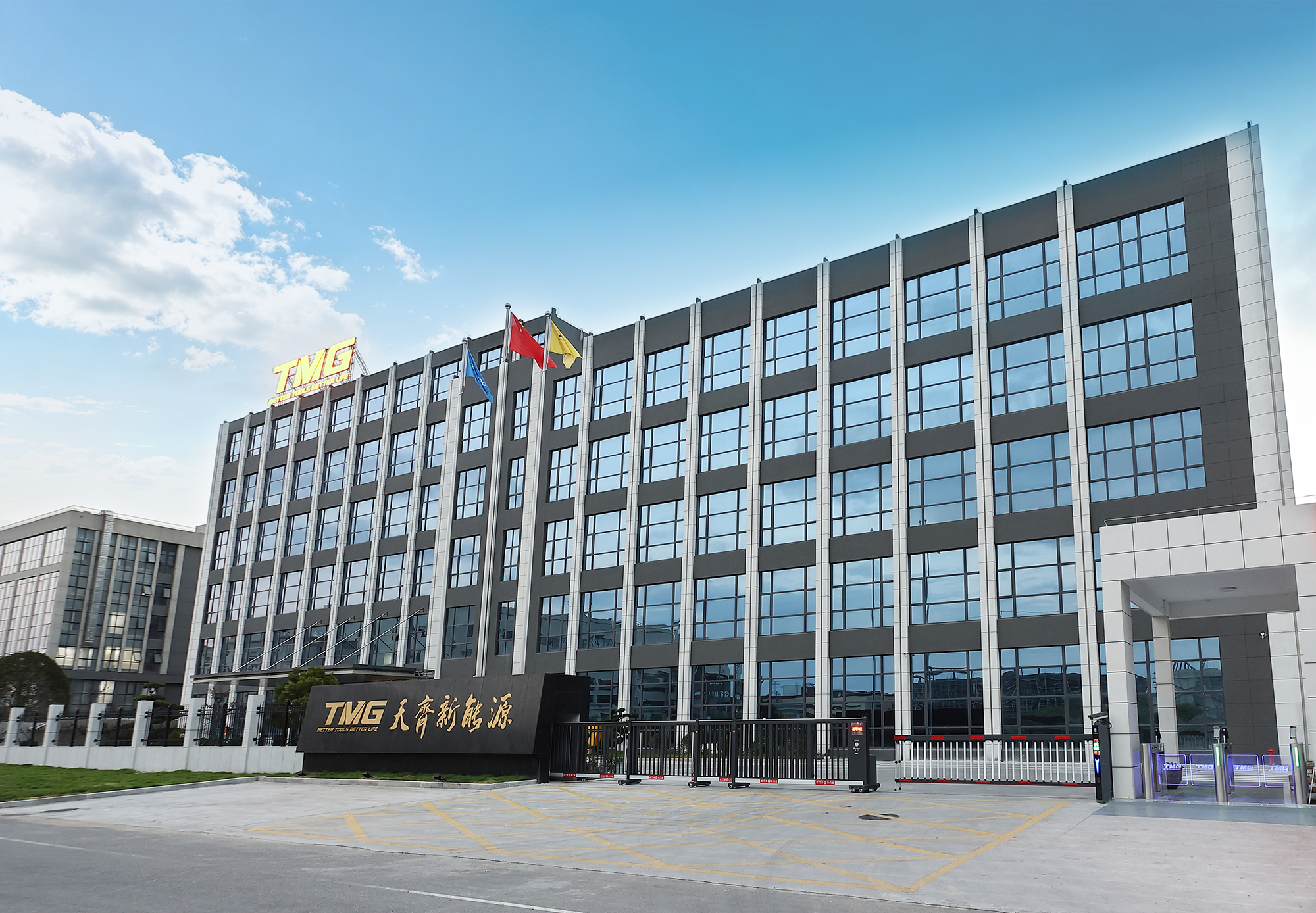
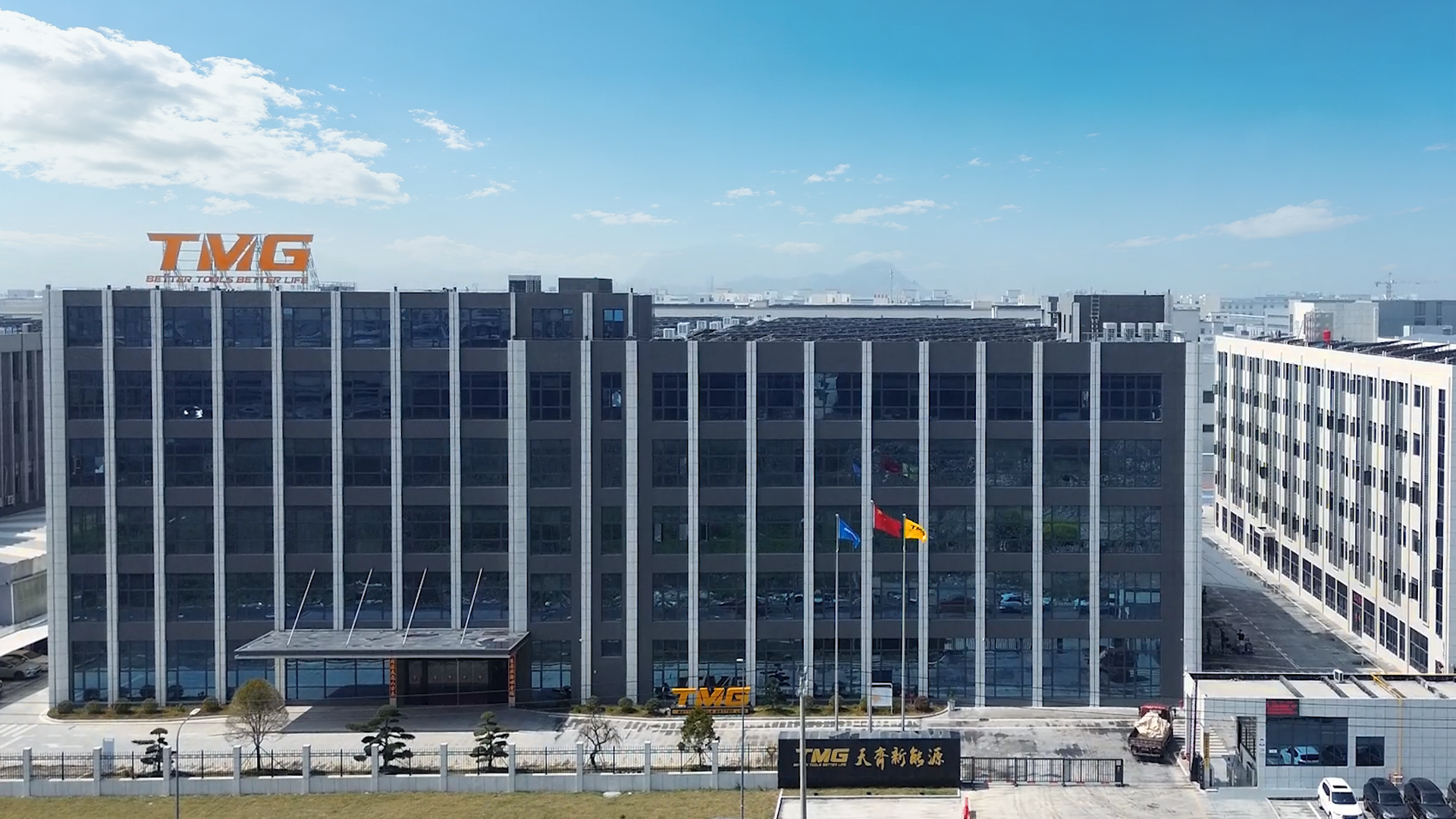
TMG Power Tools manufacturing facility, Cixi Binhai Economic Development Zone, Ningbo — R&D, molding, brushless motor production and battery pack assembly under one roof.
Step-by-Step Breakdown: Running a Continuous Grinding Pass
The features only pay back if the workflow uses them. The sequence below is written for a maintenance or light-fabrication operator working without mains power, and each step is tied to a specific AG3125S capability.
- Match speed to the task before starting. Use the lower part of the 3000–8500 rpm range for blending and finishing, and the upper part for faster material removal. Set the speed while the tool is unloaded, not during the pass.
- Set the grip with the tool in the working position. Place the soft grip in the palm with the fingers wrapped rather than pinched, and support the body of the grinder with the second hand. Check that the hand can stay relaxed — if it cannot, the stance is wrong, not the tool.
- Start the pass, then lock the switch. Bring the disc to the workpiece under control, and engage the lockable switch only once the disc is in a stable, open position and the pass is going to be continuous.
- Let constant speed control carry the load. Apply light, even pressure and let the tool hold its speed. If the pass starts to feel like pushing, reduce pressure rather than increasing it — speed, not force, is doing the cutting.
- Unlock before every repositioning. Release the lock before lifting the disc out of the work, changing angle, or moving to the next section. The lock is for the pass, not for transport.
- Plan the battery, not just the pass. Treat the 20V pack as a session budget: sequence the heaviest removal work first while the pack is fresh, and keep the finishing passes for later in the session when control matters more than speed.
The workflow point is that steps 2 to 4 substitute tool behaviour for operator effort. A grinder without a soft grip, a lock and speed control pushes the operator into a compensating pattern — tighter hold, harder push, shorter pass. The AG3125S configuration allows the opposite pattern: relaxed hold, light pressure, longer pass.
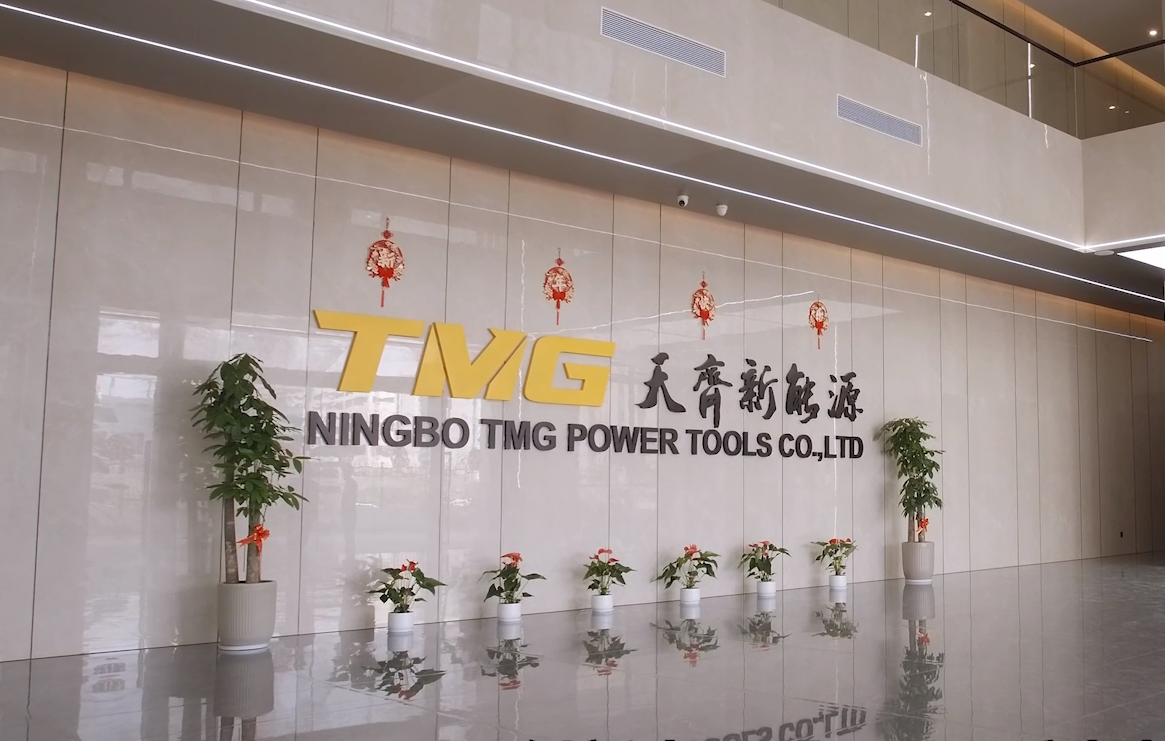
Production environment at TMG Power Tools, where brushless cordless tools are assembled and inspected before shipment.
Use Cases: Where the Fatigue Question Decides the Purchase
On-site maintenance and rust removal
Repair work on railings, gates, frames and trailers is typically a series of awkward-position passes rather than one long cut, and it usually happens where no outlet is available. A lockable switch and a soft grip matter more here than peak power, because the operator is holding the tool at an angle for the whole session.
Light fabrication and weld blending
Blending seams on small batches is a finishing task, not a cutting task. It rewards the low end of the 3000–8500 rpm range and consistent speed, because an even blend removes the need to rework the surface. Constant speed control is the relevant feature; the operator is judging finish, not removal rate.
Fleet, plant and rental maintenance
In fleets and rental operations the tool is used by different operators with different habits. A lockable switch and predictable speed reduce the variation between users, and the 20V Li-ion platform keeps the tool usable in yards and depots where power access is inconsistent.
Private-label and distributor programmes
For distributors building their own brand, the ergonomic and control features described here are also the differentiation points in a catalogue: grip, switch and speed control are what an end user notices in the first minute of handling the tool. TMG provides both OEM and ODM production, with customization covering color, logo, packaging and new designs, plus custom carton and private-label packaging and retail kit design for private-label brands.
Comparison Table: Feature, Operational Effect and What to Verify
The table below converts the AG3125S feature set into verification actions. It is deliberately limited to the features confirmed for this model — nothing here is a measured performance claim.
| AG3125S feature | Operational effect for the operator | What to verify on a sample |
|---|---|---|
| Ergonomic soft grip | Lowers the grip force needed to keep the tool stable over a run of passes | Hold the tool in the working position and confirm the hand can stay relaxed |
| Lockable switch | Allows the hand to relax during a continuous pass instead of holding the trigger | Check engagement and release action, and confirm the release is easy to operate with a gloved hand |
| Constant speed control | Holds set speed as load changes, so the pass is driven by speed rather than pressure | Load the disc in the material and observe whether speed holds without extra push |
| 3000–8500 rpm no-load speed range | Provides a low end for controlled finishing and a high end for faster removal | Confirm the low end is usable for blending and that speed selection is reachable during work |
| 20V Li-ion battery | Removes the mains dependency that limits where grinding work can be done | Confirm the battery platform and pack fit match your existing programme |
| Brushless motor | Removes the brush contact interface and supports speed consistency on a battery platform | Confirm motor type in the specification sheet for the exact SKU ordered |
For buyers evaluating TMG as a production partner rather than a single tool, the commercial programme is a separate comparison set. These are stated terms, not estimates.
| Programme item | Stated terms |
|---|---|
| Production mode | OEM and ODM |
| Customization scope | Color, logo, packaging and new designs; custom carton and private-label packaging; retail kit design for private-label brands |
| Minimum order quantity | 500 pcs |
| Lead time | 45–55 days |
| Monthly capacity | 600,000 units |
| Delivery terms | FOB Ningbo |
| Payment terms | TT 30% deposit, balance against copy of BL |
| Quality control | AQL test; acceptance criteria include pre-shipment test |
| After-sales | Remote support and spare parts support for quality issues; spare parts supply for ongoing orders and long-term supply programmes |
| Certification | ISO 9001:2015 and ISO 14001:2015, certificate 15/25E01889R00; BSCI result 156-065164-000 (amfori Social Audit) |
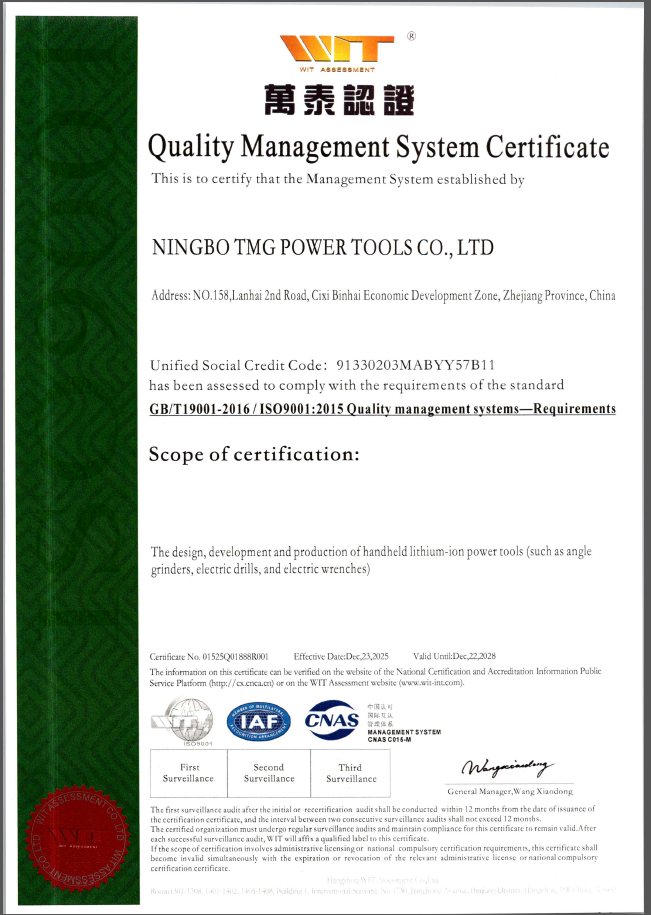
ISO 9001:2015 and ISO 14001:2015 certificate 15/25E01889R00, TMG Power Tools.
FAQ
1. Which certifications should a buyer verify when sourcing a Chinese OEM cordless angle grinder with brushless motor customization?
Start with the certificate numbers rather than the certificate logos. TMG Power Tools holds ISO 9001:2015 and ISO 14001:2015 under certificate 15/25E01889R00, and a BSCI result numbered 156-065164-000 issued through an amfori Social Audit. On the quality side, TMG states AQL testing as its quality-control method. A buyer should confirm that the certificate scope covers the product being ordered, and check the certificate number directly rather than relying on a downloaded image.
2. Can this manufacturer customize a brushless cordless angle grinder for a private label?
Yes. TMG provides both OEM and ODM production services, and customization covers color, logo, packaging and new designs, including custom carton and private-label packaging as well as retail kit design for private-label brands. Brushless motor production sits inside TMG’s own manufacturing scope, alongside precision molding and intelligent battery pack assembly, and an 18-engineer R&D team supports design work. Buyers should confirm in writing which of these items apply to the specific SKU and order.
3. What order quantity and payment terms apply to an OEM order?
The minimum order quantity is 500 pcs. Delivery terms are FOB Ningbo, and payment terms are TT 30% deposit with the balance against a copy of the bill of lading. Acceptance criteria include pre-shipment testing. Because MOQ and trade terms sit above a single-tool purchase, buyers who only need one unit for evaluation should approach the tool as a sample enquiry rather than a production order.
4. How should a buyer validate the soft grip, lockable switch and constant speed control before committing?
Validate on the workpiece, not on a bench. Hold the AG3125S in the position it will actually be used in and check whether the soft grip allows a relaxed hold; engage and release the lockable switch with a gloved hand; and load the disc in the material to see whether constant speed control holds rotation without the operator adding pressure. Set the speed at the low end of the 3000–8500 rpm range for a finishing pass and at the high end for removal, so both ends are tested. Formal acceptance is then defined by the stated pre-shipment test and AQL inspection.
5. What is the lead time, and what support continues after delivery?
Lead time is 45–55 days, against a monthly capacity of 600,000 units. After delivery, after-sales service includes remote support and spare parts support for quality issues, and spare parts supply is provided for ongoing orders and long-term supply programmes. Buyers who want to discuss a sample, a specification change or a private-label programme around the AG3125S can contact TMG Power Tools directly at sales@tmgtools.com, on WhatsApp at +86 18658419921, or through www.tmgtools.com.
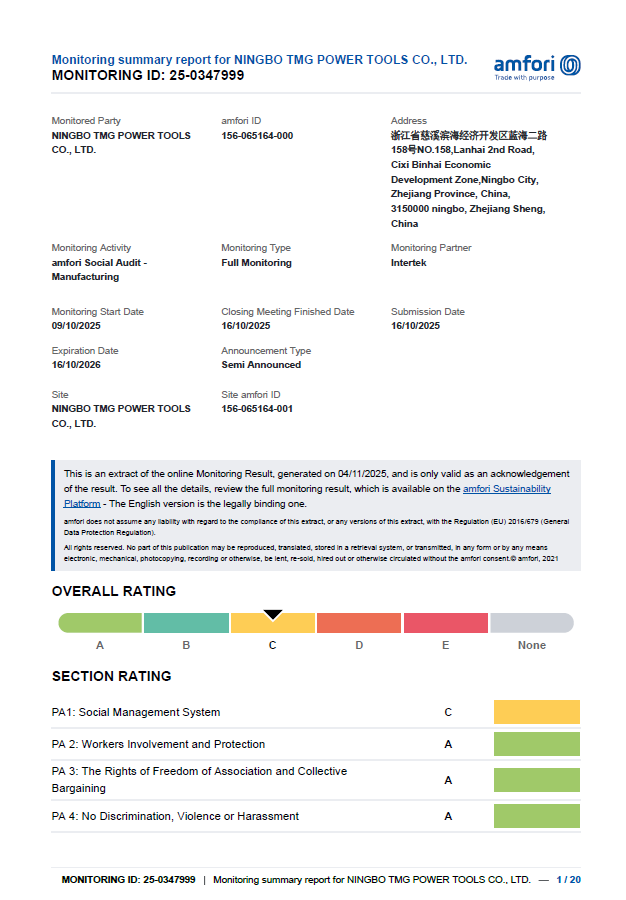
BSCI result 156-065164-000, amfori Social Audit, held by TMG Power Tools.
Conclusion: Fatigue Reduction Is a Configuration Choice
A cordless angle grinder does not become easier to use because of a single specification. It becomes easier to use when the grip reduces the force needed to hold it, the switch lets the hand relax during a continuous pass, and the tool holds speed so the operator does not substitute pressure for rotation. On the AG3125S those three functions are addressed by the ergonomic soft grip, the lockable switch and constant speed control, with a 3000–8500 rpm no-load speed range, a 20V Li-ion battery and a brushless motor providing the working envelope.
For a maintenance team or a light-fabrication shop, the practical test is not a comparison of numbers. It is a pass run on the actual workpiece, held in the actual position, with the switch locked and the speed set — and then the question of whether the hand is still relaxed at the end of it. For a distributor, the same features are the ones that survive the first minute of a customer’s handling in a showroom, which is why they belong in a private-label specification rather than a generic one.
Next step: request an AG3125S sample, a specification sheet for your market, or an OEM/ODM quotation from TMG Power Tools. The programme starts at 500 pcs with a 45–55 day lead time, and customization covers color, logo, packaging and new designs.
www.tmgtools.com | sales@tmgtools.com | WhatsApp +86 18658419921
Ningbo TMG Power Tools Co., Ltd. — No. 158, Lanhai 2nd Road, Cixi Binhai Economic Development Zone, Ningbo, Zhejiang, China 315300
Have Questions or Need More Details?
Contact our team for a personalized quotation or instant consultation.
Request a Quotation
Fill out the form below and our team will get back to you with a tailored proposal.
WhatsApp Direct Chat
Prefer to chat in real-time? Message us on WhatsApp for instant assistance & quick answers.
- Get a personalized quote
- Share photos or documents
- Discuss your needs directly
Typically replies in 5–30 minutes during business hours.