
Cordless Angle Grinder Manufacturers: How to Identify and Evaluate a Reliable Factory
Cordless Angle Grinder Manufacturers: How to Identify and Evaluate a Reliable Factory
Cordless angle grinder manufacturers are factories that design and build battery-powered angle grinders — including the motor, the tool body and, in integrated operations, the battery pack — rather than companies that buy finished units and print a new brand name on the housing. For importers, distributors and brand owners at the awareness and research stage, the practical task is separating genuine manufacturing capability from trading activity, and then matching that capability to the specification your market actually needs.
This guide covers what the term means in practice, why the category has moved toward brushless battery platforms, which specifications decide whether a tool is fit for a given job, and how to evaluate a supplier before committing to a first order. The TMG Power Tools AG3125S — a 20V 5-inch brushless cordless angle grinder — is used throughout as a concrete reference point, so every evaluation criterion is tied to a real specification rather than a marketing claim.
Short answer: a genuine cordless angle grinder manufacturer can show you where the tool is built, which production steps happen in-house, and a full written specification for the model you intend to sell. Everything else — catalogue PDFs, generic factory photos, verbal assurances about quality — is not evidence. Use the specification, the production structure and a tested sample as the three filters.
What "Cordless Angle Grinder Manufacturer" Actually Means
In the power tool supply chain, the word manufacturer is applied to three different business models, and they behave very differently once an order is placed.
- Trading company: sources finished tools from one or more factories, adds branding, packaging and export documentation. Practical for small mixed orders; limited control over specification changes or component sourcing.
- Assembler: buys motors, housings and battery packs from third parties and assembles the final tool. Its real capability is only as strong as its component suppliers, and a component change upstream can alter the delivered product without notice.
- Integrated manufacturer: controls design, molding, motor production, battery pack assembly and end-of-line testing internally. This is the structure that allows specification changes, custom battery configurations and repeatable quality across multiple production runs.
The difference becomes visible when your requirement is not a standard catalogue item: a different spindle thread, a specific guard design, a private-label housing, a custom battery interface, or simply the same tool built to the same tolerance in the second year as in the first.
Decision rule: if your requirement involves customization, multi-year repeat orders or a multi-tool battery platform, verify manufacturing depth before anything else. If you only need small quantities of standard tools quickly, an experienced trading partner can be the practical choice — provided you understand exactly where the specification risk sits.
Why the Category Moved to Brushless Cordless Platforms
Angle grinders are among the most power-hungry tools in any battery system. Cutting and grinding demand sustained current draw, which is why corded grinders held the professional market for so long. Two developments shifted the balance: higher-capacity lithium-ion packs, and the mainstream adoption of brushless motors.
A brushless motor replaces the carbon brush and commutator with electronic commutation. In practice this typically means better electrical efficiency, more runtime per charge, less heat build-up and no brush replacement as a maintenance item. Those characteristics matter more on a grinder than on a drill, because a grinder runs under continuous load for longer periods.
Two consequences follow for buyers:
- Electronics became part of the specification. Soft start, constant speed control, anti-restart and battery capacity indication are electronic functions rather than mechanical ones, so a supplier's electronics and motor-control engineering directly shapes how the tool behaves in the operator's hands.
- Battery platforms became purchasing decisions. Distributors increasingly want one battery and charger system covering a family of tools — drill, hammer drill, impact driver, impact wrench, grinder. For the end user this reduces SKU and charger clutter; for the distributor it increases battery and accessory attachment within the same customer base.
That is why the supplier question and the platform question are now the same question. A factory that can build one tool is a component in your supply chain; a factory that can build a consistent platform is a long-term sourcing partner. It is equally worth stating the boundary: cordless is not automatically the right answer everywhere. Corded tools still make sense where continuous runtime and lowest unit cost dominate, and the useful sourcing conversation is about which jobs genuinely require battery operation.
TMG Power Tools: An Integrated Cordless Power Tool Manufacturer
Ningbo TMG Power Tools Co., Ltd is a manufacturer of lithium-ion cordless power tools and outdoor power equipment, established in 2014 and located in the Cixi Binhai Economic Development Zone, Ningbo City, Zhejiang Province, China. The company's products are sold under the TMG Power Tools brand.
Scale and structure, as published by the company: founded in 2014; 58,000 m² of manufacturing space; 210 employees; annual output of 6,600,000 units; an 18-engineer R&D team; approximately 90% export ratio; main markets in South America, Eastern Europe and North America.
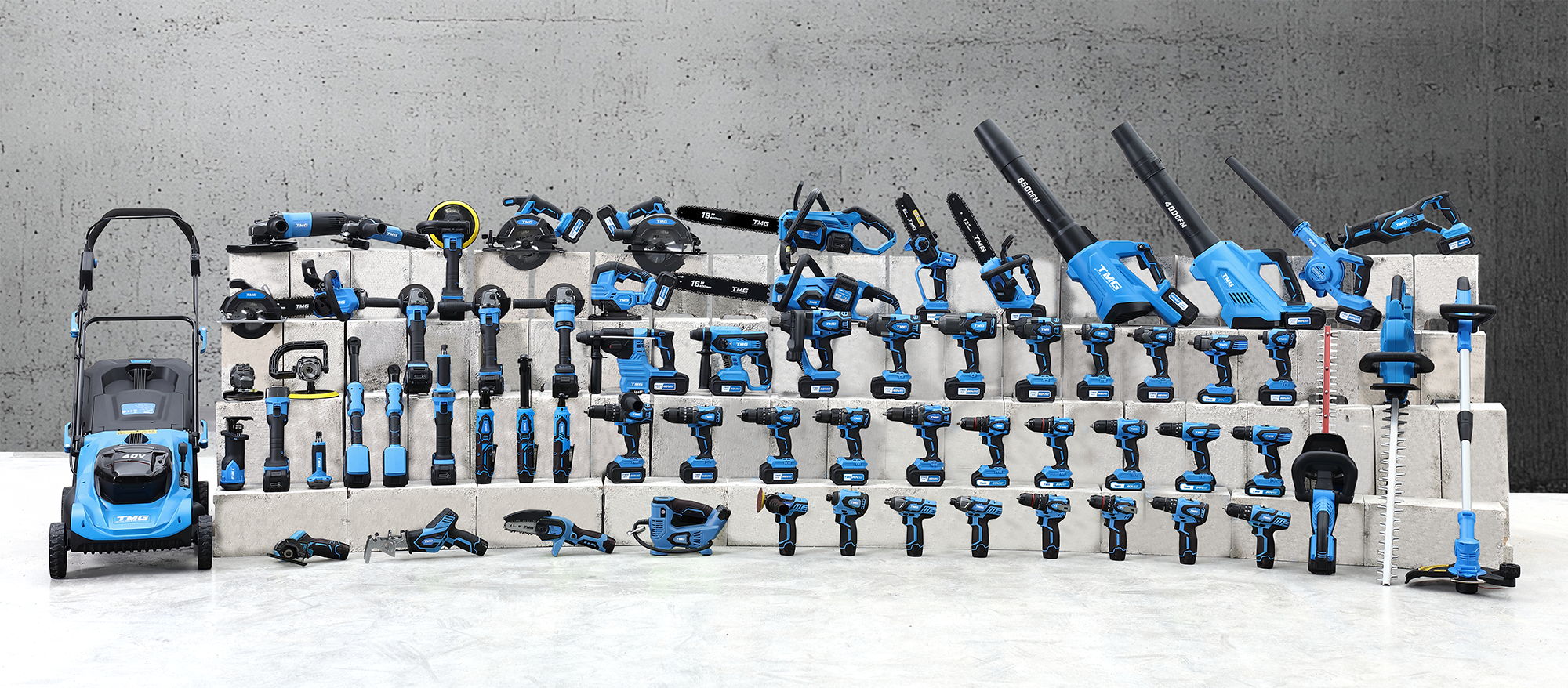
What matters in supplier-evaluation terms is vertical integration. R&D, precision molding, brushless motor production, intelligent battery pack assembly and quality testing are carried out under one roof instead of being coordinated across external vendors. The cordless range covers brushless drills, brushless hammer drills, brushless impact wrenches, brushless impact drivers, brushless angle grinders and garden tools — a set built around a shared battery and charger architecture rather than a collection of unrelated items.
For a buyer, that structure answers three questions a trading company usually cannot: who controls the motor, who controls the battery pack, and who is accountable when a specification has to change.
The AG3125S: What to Look At on a 20V Brushless Cordless Angle Grinder
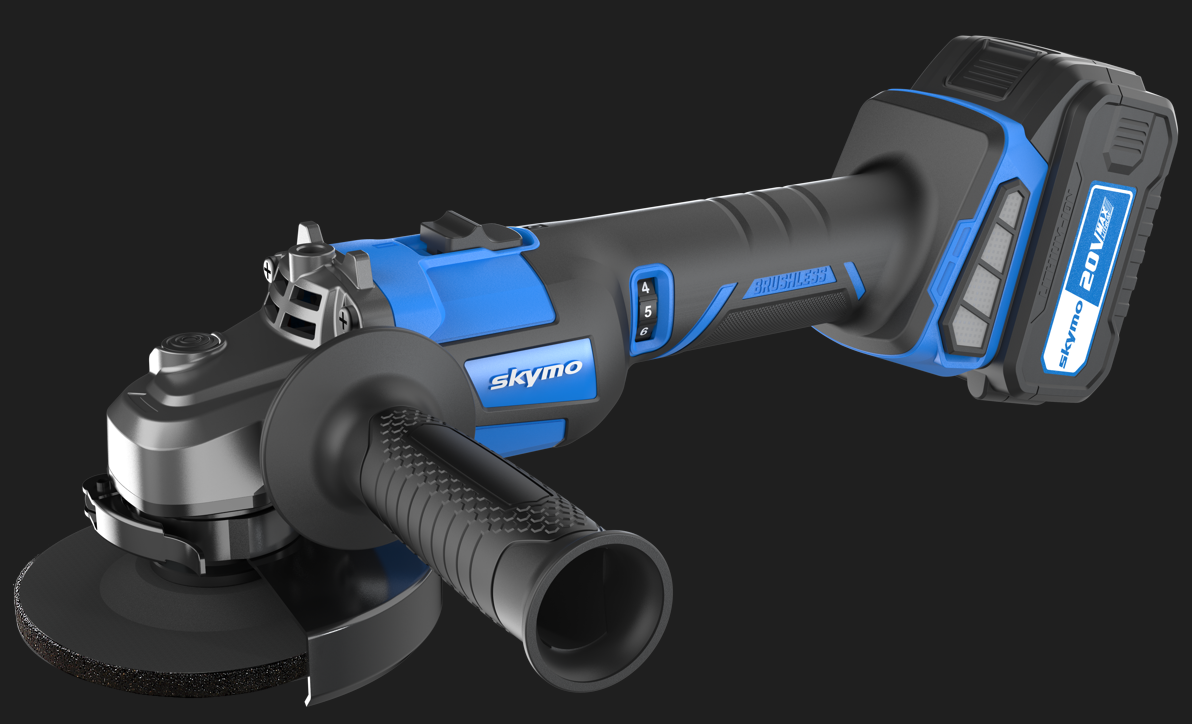
The AG3125S is a 20V 5-inch brushless angle grinder in the TMG range. Its published specification is useful less as a product description than as a checklist of the parameters that determine whether any cordless angle grinder will fit a given market.
| Parameter | AG3125S specification | Why it matters in supplier evaluation |
|---|---|---|
| Type | 20V 5-inch brushless angle grinder | Confirms motor type and voltage class in one line — the two fields that change cost, runtime and maintenance profile. |
| No-load speed | 3000–8500 rpm | An adjustable band allows cutting and surface work on one machine; a fixed single speed is less flexible. |
| Max. wheel diameter | 125 / 115 mm | Dual compatibility reduces SKU count where 115 mm and 125 mm discs dominate different markets. |
| Max. wheel thickness | 6 mm | Defines the cutting and grinding range the guard and spindle can accommodate. |
| Bore diameter | 22.23 mm | Must match the accessory standard available in your market. |
| Spindle thread | M14 / M16 | The interface dimension deciding which flanges, discs and attachments customers can mount. |
| Construction | Li-ion battery, brushless motor, plastic housing | States battery chemistry, motor architecture and housing material in verifiable terms. |
Reading the specification like a buyer rather than a spec sheet reader:
- Adjustable speed range: a 3000–8500 rpm band lets the same tool handle cutting at high speed and surface preparation at lower speed, reducing the number of models a distributor must stock.
- Tool-free guard adjustment: shortens setup time between operations, which matters wherever one operator switches between cutting and grinding repeatedly.
- Brushless motor with soft start: soft start limits the initial torque kick at switch-on, improving control at the start of a cut.
- Constant speed control: holds rpm under load instead of sagging, which is the difference between a predictable cut and a stalling wheel.
- Switch lockable and battery capacity indicator: usability and planning features for the operator working away from a charger.
- Anti-restart function: prevents unexpected start-up after a power interruption — a safety behavior that should be confirmed rather than assumed.
- Ergonomic soft grip: relevant for long sessions and for end users who compare tools hand-to-hand in a shop.
Step-by-Step: How to Evaluate a Cordless Angle Grinder Manufacturer
Seven checks, arranged in the order that prevents the most expensive mistakes.
- Define the job before the tool. Cutting, grinding or polishing; intermittent workshop use or continuous site use; metal, masonry or mixed materials. These answers determine wheel diameter, speed range and battery capacity class — and they are the questions a competent manufacturer will ask you back.
- Confirm the motor type in writing. Brushed or brushless changes runtime, maintenance tasks and price level. Ask for motor construction to appear on the quotation, not only in a brochure.
- Map the battery and charger platform. If the same order includes cordless impact wrenches, drills or drivers, confirm voltage class, pack interface and charger compatibility across the whole range.
- Verify the mechanical interface. Spindle thread, bore diameter, wheel diameter and maximum wheel thickness must match the accessories sold in your market. A tool that accepts only one disc format is a returns risk you inherit from your customers.
- Check in-house production depth. Ask which steps happen inside the factory: motor production, battery pack assembly, molding, end-of-line testing. Integrated production shortens the distance between a requested change and a shipped order.
- Validate with a sample. Order the exact configuration you intend to sell and test it in your own application under load — not in a bench demonstration.
- Confirm documentation and after-sales structure. Spare parts availability, warranty terms and the product documentation your destination market requires should be agreed before the first order, not after a problem appears.

Where Cordless Angle Grinders Are Used, and What It Implies for Sourcing
TMG's published application data for the AG3125S describes the core working condition plainly: cutting and polishing, battery driven. Those two operations span a wide range of professional contexts, and each context shifts which part of the specification carries the most weight.
- Fabrication and metalwork: cutting bar, tube and sheet, then dressing welds. Favors high available speed, steady rpm under load, and a guard that repositions without tools.
- Construction and site work: cutting rebar, threaded rod and channel where no mains supply is available. Favors runtime per charge and a battery capacity indicator so the operator knows when to swap packs.
- Automotive and tire service: brake and suspension work often needs cutting and surface cleaning, while the same bay usually needs a brushless cordless impact wrench for wheel nuts and fasteners. Sourcing both tools on one platform standardizes batteries and chargers across the workshop.
- Machinery maintenance: on-site repair where the tool travels with the technician. Favors a compact body, soft start and anti-restart behavior.
- Polishing and surface preparation: lower speed settings, variable control and steady rpm matter more than peak power.
When an order also includes a brushless cordless impact wrench, the checks shift to different parameters: drive size (3/8-inch, 1/2-inch and 3/4-inch are the common classes), torque category, whether the tool runs variable speed or offers adjustable torque settings, and practical features such as an LED light for low-visibility work. A cordless impact wrench kit — tool, battery, charger and case — is often the format distributors list, and high torque cordless impact wrenches used for automotive repair and tire service represent a different duty cycle from compact units used for light assembly. Sourcing these items from the same manufacturer as the grinder keeps the battery platform consistent.
The sourcing implication is straightforward: a cordless angle grinder is rarely purchased alone. Distributors and industrial end users evaluate the whole battery platform — grinder, impact wrench, impact driver, drill — as one decision, which is why platform completeness is a legitimate selection criterion rather than a sales argument.
Supply Models Compared
The table below compares the three supply structures described earlier. It is a comparison of models, not of named companies: the right choice depends on your order size, customization needs and how much specification risk you can absorb.
| Supply model | What the buyer controls | Where the risk sits | Typical fit |
|---|---|---|---|
| Trading company | Branding, packaging, order mix, shipping terms | Component and specification changes made upstream without notice | Small or mixed orders of standard tools, short time frames |
| Assembler | Final tool configuration and branding | Motor, pack and housing quality depend on third-party component suppliers | Buyers with their own component relationships and inspection capability |
| Integrated manufacturer (for example TMG Power Tools) | Specification, motor and pack configuration, customization, repeat-order consistency | Requires the buyer to define requirements clearly and validate with a sample | Distributors, importers and brand owners building a multi-tool platform |
Limits, Trade-offs and Common Buyer Mistakes
- Cordless is not always the right answer. Where runtime and lowest unit cost dominate, corded tools remain the practical choice. Cordless wins where mobility, access and setup speed matter more than continuous duty.
- Specification sheets are only comparable when they carry the same fields. A no-load speed figure without wheel diameter, bore and spindle thread does not tell you whether the tool fits your market's accessories.
- Brushless alone is not a complete specification. Soft start, constant speed control and anti-restart are electronics behaviors that differ between suppliers even when both use brushless motors.
- Buying a platform one tool at a time is a common and costly sequence. It usually ends with mixed batteries and chargers, which is a support burden for the distributor and a friction point for the end user.
- Skipping documentation requirements. Product documentation requirements differ by destination market. Request the specific documents your market requires and verify them — never assume that what is accepted in one country is accepted in another.
- Testing the sample at the bench instead of under load. Cutting and grinding expose electronics and thermal behavior that a short bench run will not reveal.
Frequently Asked Questions
What should a cordless angle grinder manufacturer be able to document before an order?
At minimum: the model number and full specification sheet, the motor type, the battery voltage class and pack interface, charger compatibility, the accessory interfaces (maximum wheel diameter, bore diameter, spindle thread), spare parts availability, and the product documentation your destination market requires. TMG publishes the AG3125S specification as a 20V 5-inch brushless angle grinder with 3000–8500 rpm no-load speed, 125/115 mm maximum wheel diameter, 22.23 mm bore and M14/M16 spindle thread. If a supplier cannot provide comparable parameters in writing, no factual comparison is possible.
Can one manufacturer supply a complete cordless platform instead of a single tool?
Yes, and for distributors it is usually the better structure. TMG Power Tools manufactures cordless brushless drills, brushless hammer drills, brushless impact wrenches, brushless impact drivers, brushless angle grinders and garden tools, so a workshop or retail range can run on a shared battery and charger system instead of mixed platforms. Confirm voltage class and pack interface across every tool you intend to range before placing the order.
How can a buyer check whether a supplier really produces brushless motors in house?
Ask which production steps happen inside the factory, then ask to see them: motor production, battery pack assembly, molding, end-of-line testing. TMG integrates R&D, precision molding, brushless motor production, intelligent battery pack assembly and quality testing within its 58,000 m² facility in Cixi Binhai Economic Development Zone, Ningbo, Zhejiang Province, China. Buyers who cannot visit can request a factory audit report or a live walkthrough of the motor and battery pack lines, which serves the same verification purpose.
Which specifications matter most on a 20V brushless cordless angle grinder?
Start with the mechanical interface, because it determines what the tool can physically do: maximum wheel diameter (the AG3125S accepts 125/115 mm), maximum wheel thickness (6 mm) and spindle thread (M14/M16). Then check the electrical behavior: no-load speed range (3000–8500 rpm on the AG3125S), soft start, constant speed control and anti-restart. Finally confirm the practical features operators notice daily — tool-free guard adjustment, switch lock, battery capacity indicator and grip ergonomics.
What is the practical next step when shortlisting cordless angle grinder manufacturers?
Narrow the list using the written specification and the production structure, then validate with a sample of the exact configuration you intend to sell, tested under load in your own application. TMG Power Tools supplies cordless angle grinders and a complete brushless cordless platform for importers, distributors and brand owners; you can request a sample, a quotation or the product catalogue by email at sales@tmgtools.com, via WhatsApp at +86 18658419921, or through www.tmgtools.com.
Conclusion: Evaluate the Factory, Not the Brochure
Choosing among cordless angle grinder manufacturers comes down to three verifiable filters: a complete written specification for the model you intend to sell, a production structure you can identify — who builds the motor, the pack and the housing — and a sample that performs under your own working conditions. Everything else is presentation.
The cordless angle grinder market has consolidated around brushless battery platforms, which means the supplier decision is now a platform decision. A factory that controls motor production, battery pack assembly, molding and testing can hold a specification steady across repeat orders and adapt it when your market requires a change. The TMG AG3125S — 20V, 5-inch, brushless, 3000–8500 rpm — is one reference point against which other suppliers' specifications can be compared on equal terms.
Request a Sample, Quotation or Catalogue
TMG Power Tools manufactures cordless angle grinders and a full brushless cordless platform — drills, hammer drills, impact wrenches, impact drivers and garden tools — from its 58,000 m² facility in Ningbo, Zhejiang Province, China.
Email: sales@tmgtools.com
WhatsApp: +86 18658419921
Website: www.tmgtools.com
Address: No. 158, Lanhai 2nd Road, Cixi Binhai Economic Development Zone, Ningbo City, Zhejiang Province, China 315300
Have Questions or Need More Details?
Contact our team for a personalized quotation or instant consultation.
Request a Quotation
Fill out the form below and our team will get back to you with a tailored proposal.
WhatsApp Direct Chat
Prefer to chat in real-time? Message us on WhatsApp for instant assistance & quick answers.
- Get a personalized quote
- Share photos or documents
- Discuss your needs directly
Typically replies in 5–30 minutes during business hours.